

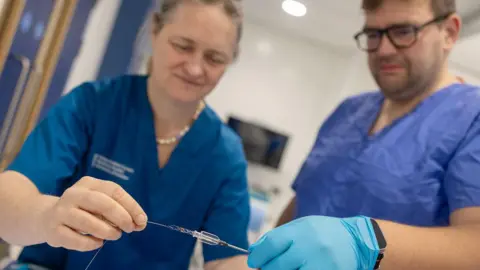
Doctors from Scotland and the United States have performed what is considered a historic stroke procedure using robotic technology.
The medical expert, associated with a research center, executed the long-distance surgery - the extraction of circulatory obstructions following a cerebral event - on a human cadaver that had been contributed to medicine.
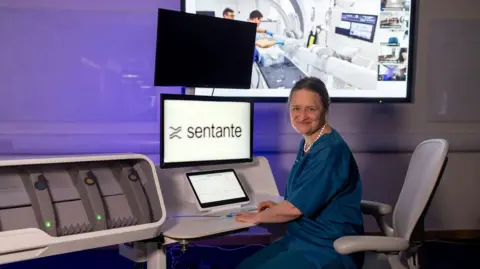
The surgeon was located at a medical facility in the location, while the body she was operating on with the device was at another location at the academic institution.
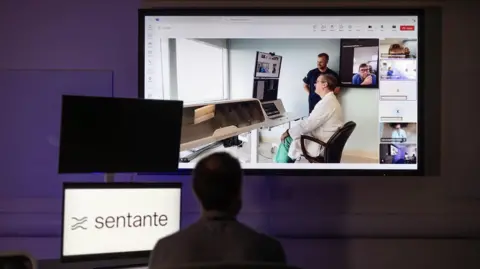
Hours later, a neurosurgeon from the American state used the equipment to perform the pioneering long-distance operation from his American facility on a human body in Dundee over significant distance away.
The research collective has labeled it a potential "revolutionary development" if it gains clearance for clinical application.
The medics consider this system could revolutionize cerebral healthcare, as a delay in accessing professional intervention can have a direct impact on the recovery prospects.
"The experience was we were seeing the initial vision of the coming era," stated the lead researcher.
"Where previously this was considered theoretical concept, we showed that each phase of the procedure can currently be accomplished."
The University of Dundee is the international education hub of the World Federation for Interventional Stroke Treatment, and is the sole location in the United Kingdom where surgeons can operate on cadavers with human blood circulated in the vessels to simulate procedures on a actual patient.
"This represented the pioneering moment that we could execute the entire surgical process in a genuine medical subject to demonstrate that every phase of the procedure are feasible," explained Prof Grunwald.
Juliet Bouverie, the chief executive of a medical organization, called the intercontinental surgery as "a remarkable innovation".
"For too long, residents of remote and rural areas have been denied availability to thrombectomy," she added.
"Such technological systems could correct the imbalance which occurs in stroke treatment across the UK."
How does the system function?
An brain attack occurs when an vascular pathway is clogged by a blockage.
This disrupts vascular flow to the cerebral tissue, and brain cells stop functioning and deteriorate.
The optimal therapy is a surgical extraction, where a specialist uses medical instruments to extract the blockage.
But what occurs when a person cannot access a professional who can perform the surgery?
The medical expert said the experiment demonstrated a robot could be linked with the identical medical instruments a specialist would typically employ, and a medic who is present with the individual could readily join the tools.
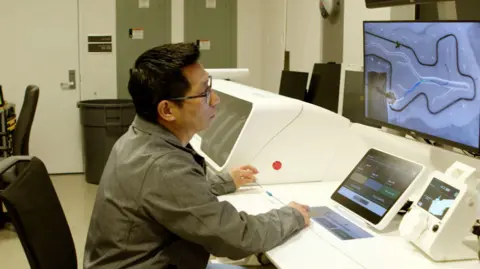
The surgeon, in a different place, could then hold and move their own wires, and the mechanical device then executes precisely identical actions in live timing on the individual to conduct the thrombectomy.
The patient would be in a treatment center, while the doctor could conduct the surgery with the advanced machine from any place - even their own home.
The lead researcher and the American specialist could see real-time imaging of the subject in the studies, and observe results in real time, with the Dundee expert stating it took merely twenty minutes of training.
Major corporations prominent manufacturers were participated in the project to guarantee the connectivity of the robot.
"To conduct procedures from the US to Scotland with a brief latency - a moment - is truly remarkable," commented Dr Hanel.
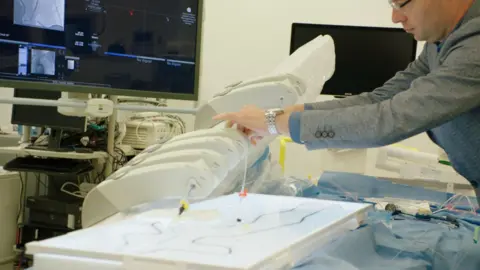
The future of stroke treatment
Prof Grunwald, who has been honored for her work and is also the executive member of the World Federation for Interventional Stroke Treatment, explained there were key issues with a standard thrombectomy - a international lack of doctors who can do it, and care is determined by your location.
In Scotland, there are only three places patients can obtain the treatment - Dundee, Glasgow and Edinburgh. If you reside elsewhere, you must commute.
"The treatment is extremely time-critical," said the lead researcher.
"Every six minutes delay, you have a one percent reduced probability of having a good outcome.
"This innovation would now deliver a novel approach where you're not reliant upon where you reside - saving the valuable minutes where your neural tissue is otherwise dying."
Medical statistics showed there were {9,625 ischaemic strokes|numerous cerebral events|


